Wednesday, April 23, 2008
USS Nimitz
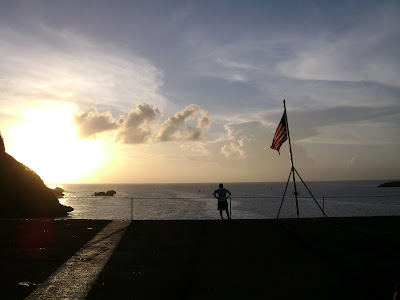
Random Sunsets
Tuesday, April 22, 2008
The Great Guamanian Car Saga Part II
Getting directions on Guam is difficult because about half the streets and roads lack signs. Oral directions involve buildings and landmarks rather than street names. For instance, "Do you know where the Burger King is Dededo? OK, drive past the Burger King then take a left at the tire swing, drive down the road until you see a big pack of dogs then take a right when you see an old refrigerator..." Needless to say, finding things can be challenging.
As Gov Guam is the epitome of a dysfunctional inefficient bureaucracy, it was highly recommended that I get to the Guam tax building at 7am to get my paperwork done before the place closed. So I took the time to drive up there after work. Traffic was the worst I have seen on Guam. It was a bumper to bumper crawl. Eventually I passed the tax building, duly noting its location, and continued on the sluggish ride home. After over an hour of traffic, I got home just in time to watch my left front tire go flat.
I checked the trunk and of course there was no tire jack. At least there was a tiny spare. Annoyed and with little patience, I removed the hub cap. I was shocked to discover that the hubcap was partially melted. The wheel was red-hot. After waiting several hours for it to cool, my roommate and I removed the wheel and put on the spare. It was clear the wheel was not spinning freely and as a consequence friction was super heating the wheel as it turned.
The next morning I went to a nearby mechanic for diagnosis. To my horror, they gave me a shopping list of repairs needed - basically an entirely new brake system for $1100. But they did repair my tire and put it back on. So now I am driving a coworker's car while she is off island. Thankfully, she offered use of the car if I needed it. But after she returns on May 5, I will have to find something else...
Monday, April 14, 2008
Hashing
Hashing is half sport-half subculture. Beginning in the 1930s in Malaysia, Hashing is still practiced across America and all over the world. Someone could describe Hashing as a cross country running/drinking club. Essentially Hashing is an overland run with several important nuances. A Hashing group meets once a week at a predetermined location. 2-3 people serve as the week's trail setters or "hares." At the rendezvous, the hares give directions on where everyone is to drive to begin the hash. Upon arrival the hares post the final destination of the run and then begin to set the trail. The hares have five to ten minutes head start before the rest of the group begins to chase them. The hares "set trail" through the jungle periodically leaving markers for the group to find. It behoves the hares to make the trail difficult and not easy for the rest of the group, the "hounds," to follow. After everyone makes it to the end of the hash, beer is ritualistically consumed around a bonfire where songs are sung and people are ridiculed.
On Saturday, after spending all day hiking around, becoming severely dehydrated and exhausted, I decided to go to the Hash anyway. It began in the northern half of the island, near Anderson Air Force Base. We ran down a road a ways and then into the jungle. Running through the jungle was difficult. At times we could manage no more than a brisk walk as we stepped over the roots, vines, plants, trees, and coconuts. After twenty minutes, I was again exhausted. I could run no more. I hiked through the trail in between the runners and the walkers.
After an hour the trail emerged in grassy clearing. I could not believe my eyes, I was in an abandoned city. It was once a housing complex that was part of Anderson Air Force Base. Now abandoned for many years, it looks as if the Apocalypse had occurred and the jungle was quickly reconquering the large dormitories, smaller apartments and family houses on once busy streets and once neatly manicured lawns. There were also wrecked cars and bullet casings everywhere adding to the post apocalyptic vibe - the military now uses the complex as an urban warfare training center. It was an amazing place to behold. Later I asked how long the place had been abandoned - it looked like decades. I was told, however, it was abandoned only ten years ago. The jungle can take over in a matter of years and decades later the place will have ceased to exist.
The trail veers back into the jungle and then into sword grass before heading down into a gorge. The sun is setting and the jungle is very dark. But I can hear voices - the end is near. The end of the trail - called the 'on home' is next to a large cave with an amazing freshwater lake inside. We all take a dip in the cave lake and begin to drink beer. A fire is started and many people leave. Most, however, stay for the fire and beer which is another story. After my first hashing experience, all I can say is, wow.
Boonie Stomping
We continue on to the waterfall, but after a while, Bret admits to leading us in the wrong direction. We move overland, finally leaving behind established trails. It is not easy. The local grass is known as sword grass and for good reason - the sides of the long leaves can cut you very easily and it can grow to over eight feet high. Bret and his friends pull out gloves, but I have none. Very soon my hands and legs are cut from the razor sharp edges of the sword grass. Pushing and manhandling your way through dense grass is an intense workout. Very soon I am exhausted. After a long struggle through heavy growth, we realize that we have gone in a large circle - right back where we started. We head back to the last tank to retrace our steps, the tank is visible on the horizon. From there, Bret finds the correct route. After a few minutes, we see the waterfall. It appears to flow into a deep hole in the earth. Bret explains that in the wet season this is an enormous waterfall with a huge volume of water, but today, in the middle of the dry season, it is but a trickle.
We veer down into the steep river valley. This is a very popular destination, clearly demonstrated by the heavily eroded path and the dozens of ropes attached to trees to help with the descent and assent. But it is worth the effort. At the bottom is a deep pool of cool fresh water. We all take a dip and jump off the cliff a few times.


After half an hour, it is 1:30 and time to head back to the car. At 4pm, Bret has to go to the weekly Hash (Detail soon to come) and I too am planning to attend the Hash. The hike back is exhausting. I am out of water and I realize two things: 1. I am out of shape 2. I am very dehydrated. It soon becomes effort just to lift my feet and keep walking. I also realize that despite the 88 degrees and 100% humidity, I have stopped sweating. That can't be good. I borrow a few sips of water and soldier on. Finally we make it back to the car and I can't remember the last time I felt so exhausted. At this point, there is no way that I will be up for any more physical activity today, let alone going to a Hash in less than two hours. But after a quick lunch from Wendy's and as much water as I can drink, I feel better and slightly more ambitious...
Island Style
Every Friday evening, nearly everyone on Guam goes to a cookout. Everywhere you look, at the beach, at the park, in backyards, in parking lots, on the side of the road, people are cooking out. They are literally everywhere. Not only are people cooking out with their families, but with friends and more often than not, random passer-bys. If you are walking by a cookout and merely wave, you will almost certainly be invited to join where great quantities of food will be heaped on a plate and pushed into your hand along with a cold Budweiser.
On my first Friday on the island (I arrived on a Friday, but it doesn't count), I joined my new friends Rick and Bruno at their mechanic garage for a cookout. I brought a 1/2 case of Budweiser, the unofficial beer of Guam. When I arrived Rick, Bruno, Bruno's family and others were already getting the fire started. Rick and Bruno left to buy food while I talked with the other folks. I spoke mostly with Bruno's nephew. Bruno and his family are from Chuk (also known as Truk), a small island atoll to the southeast, part of the Federated States of Micronesia (an independent country).
There are many Chukan people on Guam. Chukans, as well as Philippians, Chinese, and Koreans came to Guam for work. But, like everyone on Guam they observe the "Island Style." Bruno's nephew recalled how hard it was to live on Chuk. "Everyday," he said, "you spend most of your time hunting or fishing, just trying to find food to eat." Soon Rick and Bruno return and begin to cook the "chasers." Chasers are what I would call appetizers. For chasers, we have shushini - raw tuna with awesome homemade dipping sauce - excellent. Large quantities of chicken, beef, and thick bacon is put on the fire. Along with the potato salad, it is an enormous meal.
As we eat, Rick explains "this is island style." Rick says most people work six days a week on Guam, get paid little and struggle just to make it. Wages are low, prices are high and even with many people on government assistance, it can be difficult to make end's meat. Yet, everyone takes time out on Friday to chill, eat a lot of food, drink a lot of Budweiser and relax. During the evening, Bruno left two times to go to the store and purchase more food. It was nothing short of a tour de force of binge eating by everyone there (yours truly included). I can't remember the last time I was that full.
Sunday, April 13, 2008
THE GREAT GUAMANIAN CAR SAGA
- automatic transmission,
- steering wheel,
- windows,
- one side mirror,
- extensive rust,
- two bowling balls (?),
- bumper attached by bailing wire,
- a large ant colony.
I took it out for a spin and although the doors didn’t lock, the air con didn’t work, the windows took herculean effort to roll down, and the brakes took a few minutes to slow the car down, it did drive forward at slow speeds. After the drive, I offered $450 and Dan took it. Thinking back, I have to ask myself why the hell did I buy that thing? I was desperate. I just needed basic transportation that would last until I got a few paychecks in the bank to upgrade. What I got was a big mistake.
After the purchase, James followed me in my rental car to drop it off. After turning in the rental car, we jumped into my new “Guam Bomb.” But, it didn’t start; it didn’t even try to turn over. I owned the car less than 20 minutes and it was already broke down. The rental car mechanic, Rick, took a look at it and gave a summary diagnosis – “it sounds like the starter’s dead.” Rick agreed to look at it the next day. James and I got back into the rental car and left. The next day, after my first day at work, I went back to see Rick. Unfortunately, Rick hadn’t found the time to look at it. He promised he would move it two blocks away to the rental car garage on Tuesday (the next day). I called Rick on Tuesday and he said that it was indeed the starter. That night I called Dan to see what he would be willing to do. Dan had been explicit before the transaction that the car was “as is” so I did not expect him to take the car back. To his credit, Dan did offer to split the cost of the repair. I called Rick again on Wednesday to get an update. He was having difficulty finding a starter for the car. Car parts are not found in great abundance on Guam, especially car parts for vehicles other than the predominant Toyotas and Nissans. Rick called me back on Thursday to report he had obtained a rebuilt starter and would be finished later that day, but wanted to show me another car he had for sale. Rick was trying to sell a ’91 Cadillac Deville. After showing me what he and his coworker Bruno had done to replace, Bruno then went over the laundry list of additional things that need to be done. The radiator leaked, the brakes needed work, the ignition switch needed to be replaced, and on and on. They recommended that I take it back if I could – they would have nothing more to do with it.
But Rick was persuasive with his Cadillac. Not only did it start and run, but “this is no Guam Bomb,” Rick assured me. It ran very smoothly and braked well. Rick needed money immediately and agreed to multiple payments totaling $1,500 in exchange for the car. He also promised to stand behind the Cadillac if it broke down immediately. So I bought the Cadillac, still unsure of how I was ever going to rid myself of the Mitsubishi.
It also dawned on me that I still own two more cars in the states, a Ford Ranger in California and a Mercedes Benz in Tennessee. I own four cars?
After paying Rick an initial payment of $800 plus $200 for fixing the starter on the Mitsubishi, I realized how utterly broke I was. Long before my arrival on Guam, I had been leaking money like the Exxon Valdez. Not only was I required to pay my way to Guam, but I had to take care of all my incidental expenses once I arrived. I was near the braking point and I hadn't even found a place to live.
Early the next week, I called Dan to get 1/2 of the repair costs that he promised to pay. To my surprise and elation, Dan offered to take the car back and call it even (loss of $200 to me). YES! One car down. On the same day, my Dad left two messages on my cell phone. The first one: "Ben, this is Dad, I think I have someone interested in buying your car. Call me back as soon as you can." What an amazing turn of events! I need to call Dad immediately. The next message: "Ben, this is Dad. I sold your car. Give me a call back."
So as quickly as I had amassed four cars and dire financial straights, I had got rid of two and temporarily settled my money woes.