Sunday, April 27, 2008

The Brown Tree Snake

On my way back from the hash last night I spotted a snake on the road. It was the notorious brown tree snake. This was the first time I have seen the hated snake and many of my coworkers that have been on Guam for years have still never seen them. The brown tree snake arrived on Guam during or shortly following World War II. The exotic species was the first snake ever to slither through Guam's beautiful jungles and the island would never be the same. Over the past 50 years, the brown tree snake has decimated the bird population. There are practically no birds on the island. The only birds I have seen are a few swallows - an exotic species from Europe.


The brown tree snake on Guam is the first documented case of an exotic species to single handedly drive another species into extinction (unless you count human beings). No one knew it could actually happen. Here are some of the birds that are gone:

The White Throated Ground Dove: Extirpated from Guam


The Bridle White-Eye : Extirpated from Guam

Cardinal Honey eater: Extirpated from Guam

Nightingale Reed-warbler: Extirpated from Guam


Guam Rail: Endangered


Rufous Fantail: Extinct

Marianas Fruit Dove: Extirpated from Guam


Micronesian Kingfisher: Exists only in captivity


Guam Flycatcher: Extinct


Today, the brown tree snake has also been sighted on Saipan. Saipan is one of the last island where many of these birds remain in their native habitat. Rota, the other island, has a feral cat problem that is decimating the native birds.


The only good thing about the brown tree snakes' continued presence on Guam is since they have eliminated all the birds, they help control the rat population - another exotic invasive species.

1350 Guam Hashes

Yesterday was the Hagatna Hash House Harriers' 1,350th Hash on Guam. A hash has taken place on Guam every week for twenty six years. I was on hand for the occasion. It was my third hash. We began the hash at the southeast corner. It was my first time to that region. The drive from Hagatna to the start point took over 30 minutes. While the distance was far short of 30 miles, driving on Guam is a time consuming affair. There is always traffic and at no point on the island does the speed limit exceed 45 miles per hour. We parked at a school that was recently closed by the Attorney General for numerous health code violations including a large rat infestation.

This type of school closing is an all too frequent reminder of Guam's completely dysfunctional department of education. Everyone knew that this run was significant and had made arrangements to camp out and following the hash. Unfortunately, I had to work Sunday and could not stay the night. Although the hash was not as daunting as last week which involved climbing ropes down the sheer 50ft cliffs of two waterfalls, it was nevertheless challenging. The trail included many dead ends which we fell for at one time or another. After about two hours of jungle running, river crossing, hill climbing fun, we emerged near the beach wet and tired. The on home was set up for camping with mowed grass, several large tents, and torches.

For this special occasion, there were additional activities prepared (for which we had paid $14 more than the standard $6). After the standard camp fire ritual there was catered food and even a DJ! I drank bottled water as everyone else consumed mass quantities of beer. I waited for the catered food to be served before I drove back to Tumuning. Although I was disappointed that I was unable to camp out with everyone, I did enjoy the celebration. Hashing is certainly one of the best discoveries I have yet made on this island.

It appears that I will work on Saturdays in my new work schedule, making it extremely difficult or impossible to hash in the not too distant future...

Wednesday, April 23, 2008

USS Nimitz

Earlier this week a guy wandered into the visitor center. After he went through the the exhibits and watched the movie, we got to talking. Turns out he is in the navy aboard the USS Nimitz, a super carrier. He invited me back to check out the largest class of warships in the world. Of course I agreed. Normally only navy personnel and guests are allowed on the base so for me it was a "two for one" kind of opportunity. At over 100,000 tons and over 1,000 feet long, the ship is ginormous. They took me all over the ship, on the flight deck, through the hangar, crew quarters, galley, the works. I got to see the new F-18 Superhornets - It was awesome! Some photos:

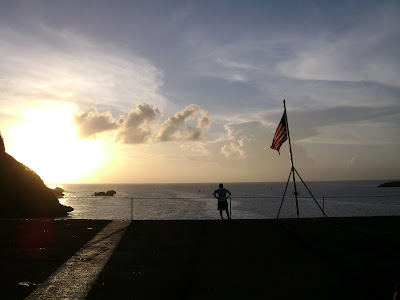
Random Sunsets

Sunsets are always amazing here on Guam. Today I realized that I don't have any on the blog, so here are a few:
Just think what I could do if I had a decent camera...

Tuesday, April 22, 2008

The Great Guamanian Car Saga Part II

Last Thursday after work, I decided to drive by the Guam tax and revenue building to see where it is. Soon, I thought, I will need to register my new Cadillac and obtain a Guam drivers license.

Getting directions on Guam is difficult because about half the streets and roads lack signs. Oral directions involve buildings and landmarks rather than street names. For instance, "Do you know where the Burger King is Dededo? OK, drive past the Burger King then take a left at the tire swing, drive down the road until you see a big pack of dogs then take a right when you see an old refrigerator..." Needless to say, finding things can be challenging.

As Gov Guam is the epitome of a dysfunctional inefficient bureaucracy, it was highly recommended that I get to the Guam tax building at 7am to get my paperwork done before the place closed. So I took the time to drive up there after work. Traffic was the worst I have seen on Guam. It was a bumper to bumper crawl. Eventually I passed the tax building, duly noting its location, and continued on the sluggish ride home. After over an hour of traffic, I got home just in time to watch my left front tire go flat.

I checked the trunk and of course there was no tire jack. At least there was a tiny spare. Annoyed and with little patience, I removed the hub cap. I was shocked to discover that the hubcap was partially melted. The wheel was red-hot. After waiting several hours for it to cool, my roommate and I removed the wheel and put on the spare. It was clear the wheel was not spinning freely and as a consequence friction was super heating the wheel as it turned.

The next morning I went to a nearby mechanic for diagnosis. To my horror, they gave me a shopping list of repairs needed - basically an entirely new brake system for $1100. But they did repair my tire and put it back on. So now I am driving a coworker's car while she is off island. Thankfully, she offered use of the car if I needed it. But after she returns on May 5, I will have to find something else...

Monday, April 14, 2008

Hashing

When James picked me up at the airport, one of the first things I noticed were his bumper stickers on his Jeep. One of them, "Hasher" piqued my curiosity. "What is Hasher?" I enquired. "That's only the greatest thing ever." James explained the basic concept of Hashing.

Hashing is half sport-half subculture. Beginning in the 1930s in Malaysia, Hashing is still practiced across America and all over the world. Someone could describe Hashing as a cross country running/drinking club. Essentially Hashing is an overland run with several important nuances. A Hashing group meets once a week at a predetermined location. 2-3 people serve as the week's trail setters or "hares." At the rendezvous, the hares give directions on where everyone is to drive to begin the hash. Upon arrival the hares post the final destination of the run and then begin to set the trail. The hares have five to ten minutes head start before the rest of the group begins to chase them. The hares "set trail" through the jungle periodically leaving markers for the group to find. It behoves the hares to make the trail difficult and not easy for the rest of the group, the "hounds," to follow. After everyone makes it to the end of the hash, beer is ritualistically consumed around a bonfire where songs are sung and people are ridiculed.

On Saturday, after spending all day hiking around, becoming severely dehydrated and exhausted, I decided to go to the Hash anyway. It began in the northern half of the island, near Anderson Air Force Base. We ran down a road a ways and then into the jungle. Running through the jungle was difficult. At times we could manage no more than a brisk walk as we stepped over the roots, vines, plants, trees, and coconuts. After twenty minutes, I was again exhausted. I could run no more. I hiked through the trail in between the runners and the walkers.

After an hour the trail emerged in grassy clearing. I could not believe my eyes, I was in an abandoned city. It was once a housing complex that was part of Anderson Air Force Base. Now abandoned for many years, it looks as if the Apocalypse had occurred and the jungle was quickly reconquering the large dormitories, smaller apartments and family houses on once busy streets and once neatly manicured lawns. There were also wrecked cars and bullet casings everywhere adding to the post apocalyptic vibe - the military now uses the complex as an urban warfare training center. It was an amazing place to behold. Later I asked how long the place had been abandoned - it looked like decades. I was told, however, it was abandoned only ten years ago. The jungle can take over in a matter of years and decades later the place will have ceased to exist.

The trail veers back into the jungle and then into sword grass before heading down into a gorge. The sun is setting and the jungle is very dark. But I can hear voices - the end is near. The end of the trail - called the 'on home' is next to a large cave with an amazing freshwater lake inside. We all take a dip in the cave lake and begin to drink beer. A fire is started and many people leave. Most, however, stay for the fire and beer which is another story. After my first hashing experience, all I can say is, wow.

Boonie Stomping

Boonie stomping is a wildly popular pass-time on Guam. Essentially, boonie stomping is hiking around the jungle. That's it. The simplicity is genius. There are no trails, no rules, you just get outside and walk around the jungle. Since the island is small, you could conceivably walk from the east coast to the west coast before lunch. Getting lost is possible but difficult. If you keep walking sooner or later you will come to a road or a village. Even though the island is small relative to the mainland U.S., the 225 square miles of island present the pedestrian with significant exploration opportunities.


On Saturday morning I accompanied my roommate Bret and two of his friends on a boonie stomp. Our destination was Singua waterfall and, upon my request, the tank farm. We drove up to Nimitz Hill to begin our stomp heading in an easterly direction. Apparently this is a popular place to begin such walks because there were several cars and a dozen people already there. In any case, we began walking down a heavily eroded 4x4 trail. Erosion caused by construction, grass fires, and 4x4s is an enormous problem on Guam. The soil, tainted with chemicals and pollution, flows directly into the ocean and immediately kills any coral reef that it contacts. Erosion has already decimated a significant amount of coral reef and threatens to destroy more if such practices remain unstopped.


We follow the trail for several miles until Bret, riding a head on a bike, locates a Sherman tank from World War II. Heavy vegetation shields the tank from view but I immediately climb on top of it anyway. Wow! A real Sherman tank destroyed by Japanese fire! Both guns and the engine have been removed, probably shortly following the war. It only occurs to me later that someone's life might have ended inside that rusting hulk.


We continue on the trail and come across yet another Sherman tank. This tank is out in the open, free of vegetation. While the guns have been removed, the enormous diesel engine is still inside - Detroit's finest. It is surprising to me that such an obviously historic object is allowed to remain out in the open to decay and rust away. But, looking around I realize how difficult it would be to move this 20 ton tank without roads.

We continue on to the waterfall, but after a while, Bret admits to leading us in the wrong direction. We move overland, finally leaving behind established trails. It is not easy. The local grass is known as sword grass and for good reason - the sides of the long leaves can cut you very easily and it can grow to over eight feet high. Bret and his friends pull out gloves, but I have none. Very soon my hands and legs are cut from the razor sharp edges of the sword grass. Pushing and manhandling your way through dense grass is an intense workout. Very soon I am exhausted. After a long struggle through heavy growth, we realize that we have gone in a large circle - right back where we started. We head back to the last tank to retrace our steps, the tank is visible on the horizon. From there, Bret finds the correct route. After a few minutes, we see the waterfall. It appears to flow into a deep hole in the earth. Bret explains that in the wet season this is an enormous waterfall with a huge volume of water, but today, in the middle of the dry season, it is but a trickle. We veer down into the steep river valley. This is a very popular destination, clearly demonstrated by the heavily eroded path and the dozens of ropes attached to trees to help with the descent and assent. But it is worth the effort. At the bottom is a deep pool of cool fresh water. We all take a dip and jump off the cliff a few times.


After half an hour, it is 1:30 and time to head back to the car. At 4pm, Bret has to go to the weekly Hash (Detail soon to come) and I too am planning to attend the Hash. The hike back is exhausting. I am out of water and I realize two things: 1. I am out of shape 2. I am very dehydrated. It soon becomes effort just to lift my feet and keep walking. I also realize that despite the 88 degrees and 100% humidity, I have stopped sweating. That can't be good. I borrow a few sips of water and soldier on. Finally we make it back to the car and I can't remember the last time I felt so exhausted. At this point, there is no way that I will be up for any more physical activity today, let alone going to a Hash in less than two hours. But after a quick lunch from Wendy's and as much water as I can drink, I feel better and slightly more ambitious...